Vinyl Acetate Ethylene (VAE) offers a variety of advantages over traditionally used Styrene Butadiene Rubber (SBR): it hardly emits any volatile organic compounds, provides greater flame-retardance and is practically odourless. The specific structure of VAE copolymers allows for an optimisation of strength and flexibility, characteristics that are especially valuable for carpet backings. Similar to SBR, VAE dispersions consist of two building blocks that deliver stiffness (vinyl acetate) and flexibility (ethylene). Using ethylene ensures high adhesive strength that maintains good flexibility which enables the use of VAE as precoat and/or secondary coating in tufted carpets. Tuft bind and lamination qualities of VAE dispersions are equal to those of SBR.
Low emissions
VAE dispersions produce low emissions of volatile organic compounds (VOCs). Further, no emissions of styrene and 4-PCH (4-phenylcyclohexene) can be detected. VOCs are chemicals used to manufacture and maintain building materials, interior furnishing and cleaning and personal care products. These carbon based chemicals evaporate into the air, often in indoor environments. Since their surface area is large, floor coverings have high potential to emit such VOCs to the environment.
The difference in emissions of VOCs is displayed in the test results of a carpet which has been tested with both an SBR and VAE backing. For the complete test results, please contact us using the contact form.
.png)
Reduced flammability
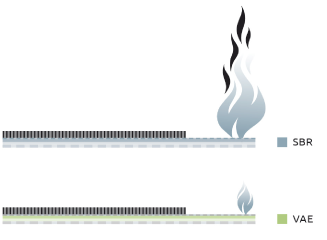
VAE dispersions have a lower flammability compared to SBR. Samples of polymer films with calcium carbonate tested in a fume chamber resulted in the SBR films burning and emitting black smoke whereas the VAE films only burnt slightly, producing white smoke or being self extinguishing. Aluminum trihydrate (ATH) content, used to achieve flame retardant properties in carpets, can be reduced significantly when using VAE dispersions.
Odourless
Traditionally, new carpets have a typical smell coming from 4-PCH or 4-VCH (4-vinylcyclohexene), by-products from SBR. Carpet backings based on VAE therefore do not have this typical smell and produce significantly lower odour during production and an odourless new carpet.
In the press
Different articles and publications in the press have paid attention to the discussions surrounding SBR and the emissions of VOCs. Please find links to the documents below (information by third parties; a new window will open).
A report by the World Health Organization, CICAD: 1,3-Butadiene: Human Health Aspects (2001)
PRO-DIS information about VOCs and carpets
An article in the Contract Flooring Journal: VOCs in buildings can kill you (July 2014)
For more information or test results, please contact us using the contact form.
Copyright © 2014  The Netherlands | info@ceneva.nl
